Guardian — from security alerts to resolved problems
An AI security agent that doesn't stop at the alert. It explains the risk, guides the fix and verifies the result.
At a glance
01 Problem
Security tools detect problems well, then leave people alone with the warning
GoalMove people from "I got an alert" to "it is fixed and I can see it".
Challenge
How do you turn a stream of technical security alerts into something an ordinary person understands, acts on and trusts, without fear tactics and without the system taking control away from them?
Outcome
Designed and clickable end to end: alert, explanation, guided fix, verified result. Real-world effect is not measured yet; the validation plan defines how.
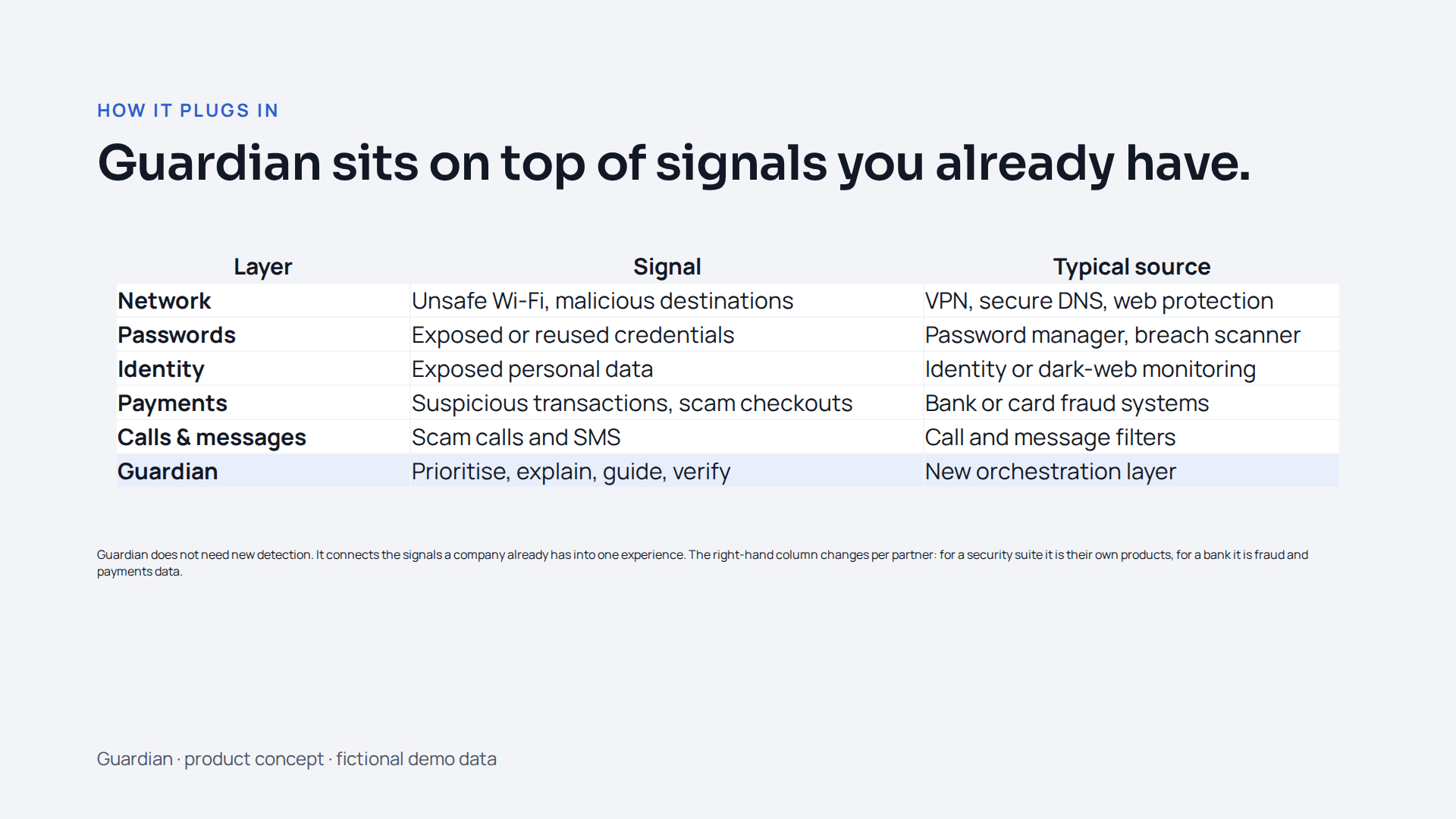
Security products detect problems well, but each signal lives in a separate product with its own alerts and language. Users are told something is wrong, then work out the fix alone across several apps. Even when protection works, its value stays invisible.
02 Users
Built for ordinary people who get a breach alert and don't know what to do next.
Deliberately out of scope New detection technology, silent changes to accounts, and any paywall in front of a warning.
03 Research
Starting from three assumptions, to be tested with real people.
Desk research and public product information, plus an accessibility review. User interviews, a prototype test and a pilot are planned, not yet run.
- Assumption: alerts end where the work begins People get a warning but no guidance on fixing it across apps
- Assumption: panic produces bad decisions Urgency must come from hierarchy and plain language, not red screens
- Assumption: invisible protection is not renewed Showing what improved gives a reason to keep paying
04 Process
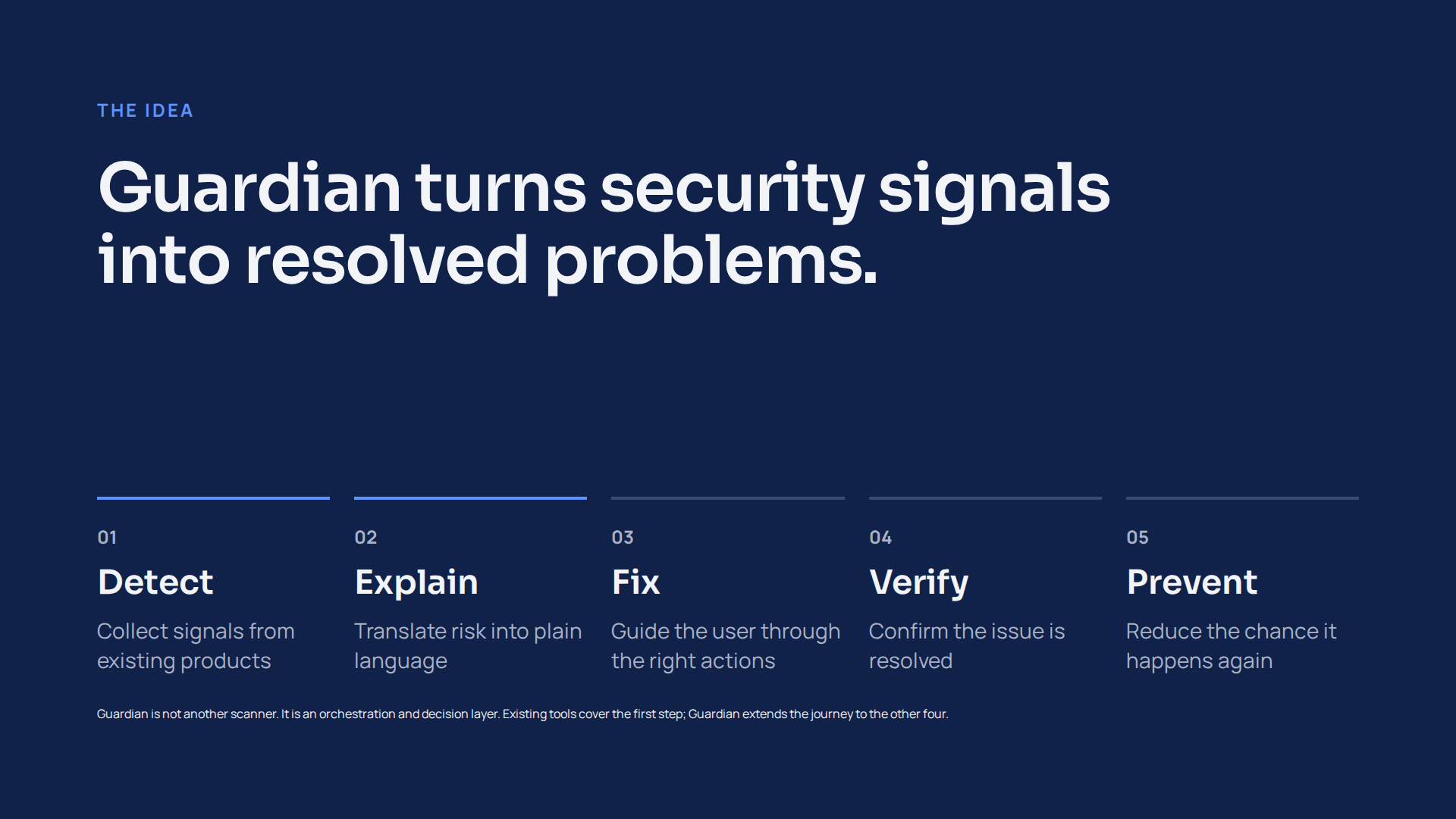
One product model: detect, explain, fix, verify, prevent.
Today: from alert to fix
5 steps- 01 Alert arrives GoalKnow something is wrong FrictionTechnical wording, no explanation
- 02 Work out what it means GoalUnderstand the risk FrictionJargon, so people search the web
- 03 Find the right place GoalReach the change-password page FrictionSeveral apps and websites
- 04 Fix it alone GoalChange the password FrictionReused passwords stay unchanged
- 05 No confirmation GoalKnow it worked FrictionThe value of protection stays invisible
Detection works. Everything after it is left to the user.
With Guardian
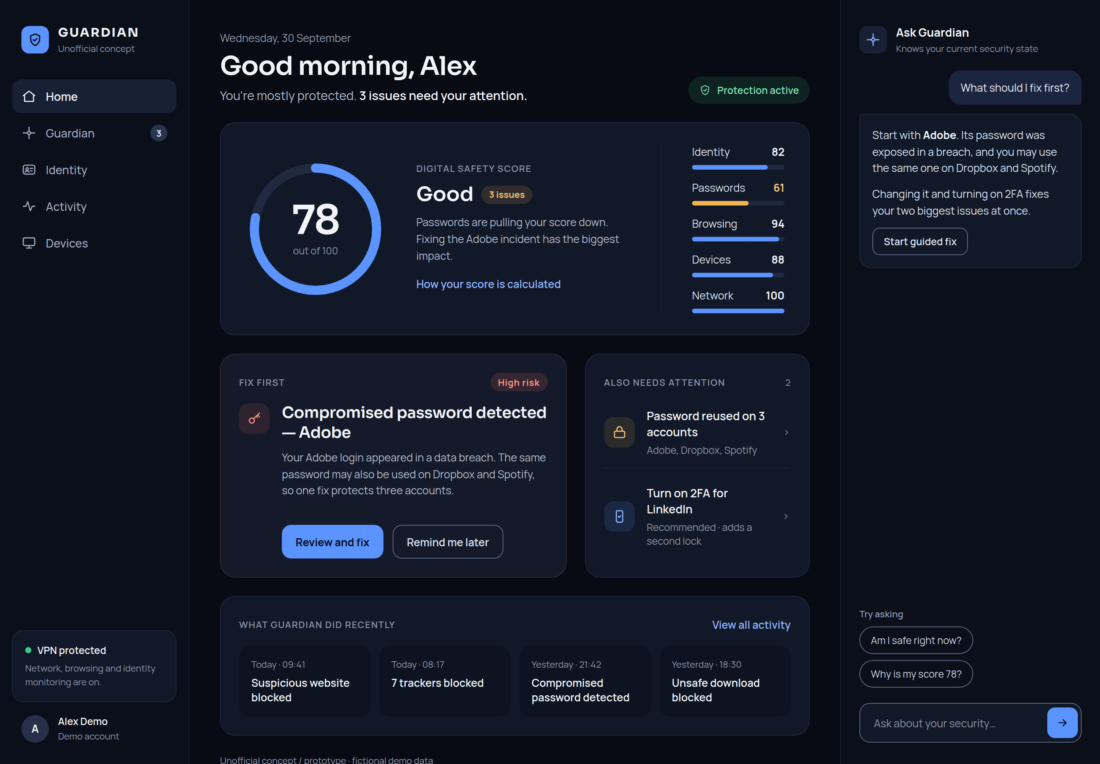
5 steps- 01 Open GoalScore is 78, three issues need attention
- 02 Alert GoalAdobe credentials were exposed in a breach
- 03 Understand GoalGuardian explains why reuse makes it risky
- 04 Resolve GoalNew password, reused ones replaced, 2FA on
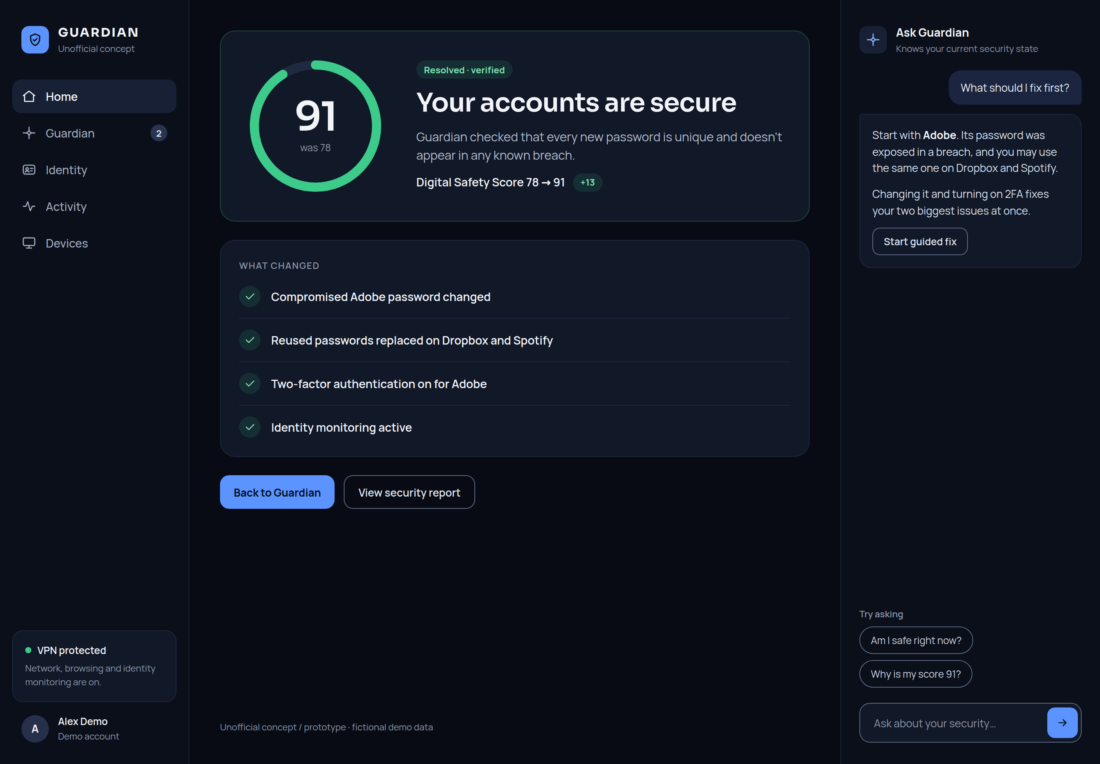
- 05 Result GoalVerified, and the score rises to 91
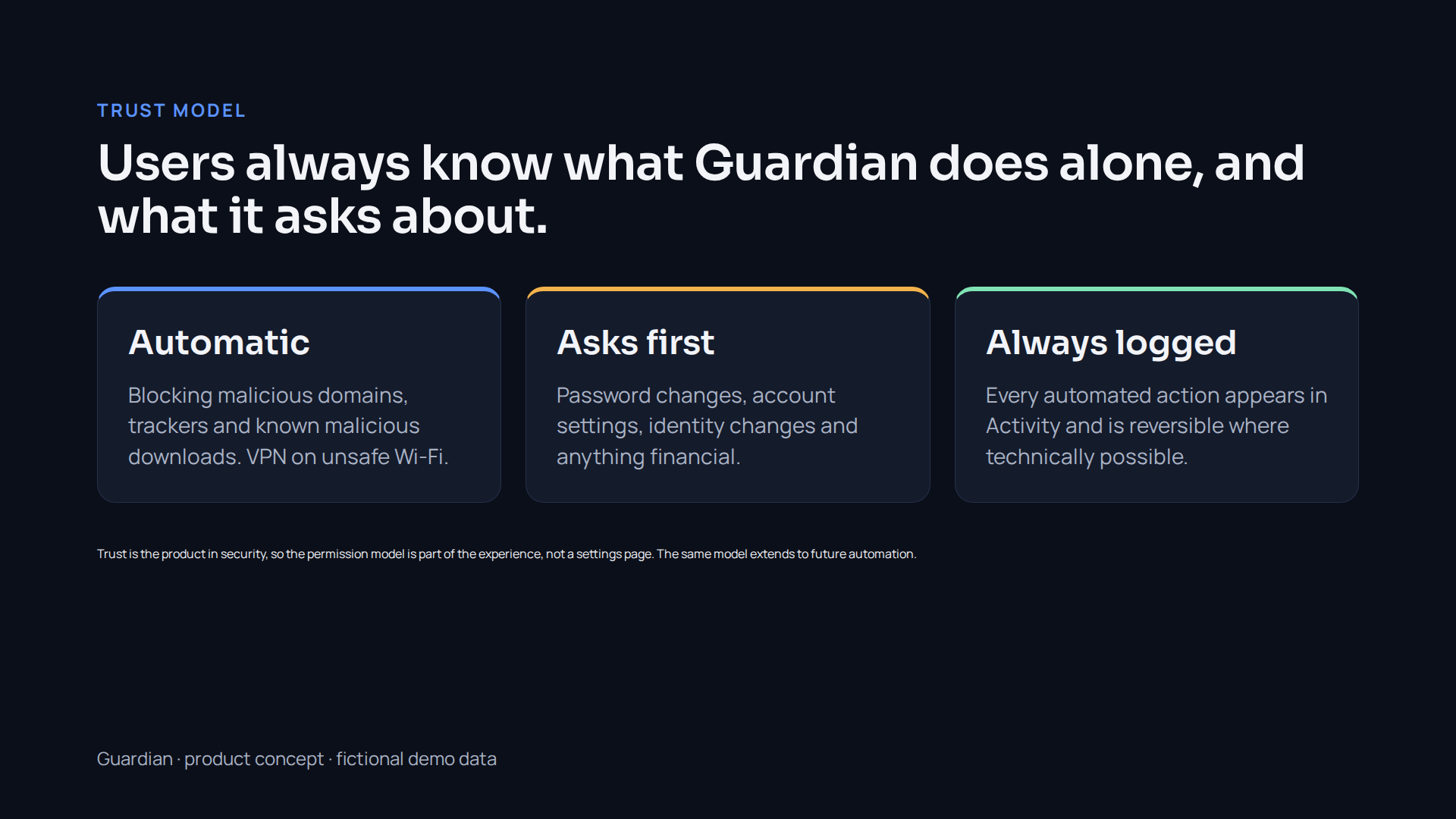
The user confirms every change.
Guided fix
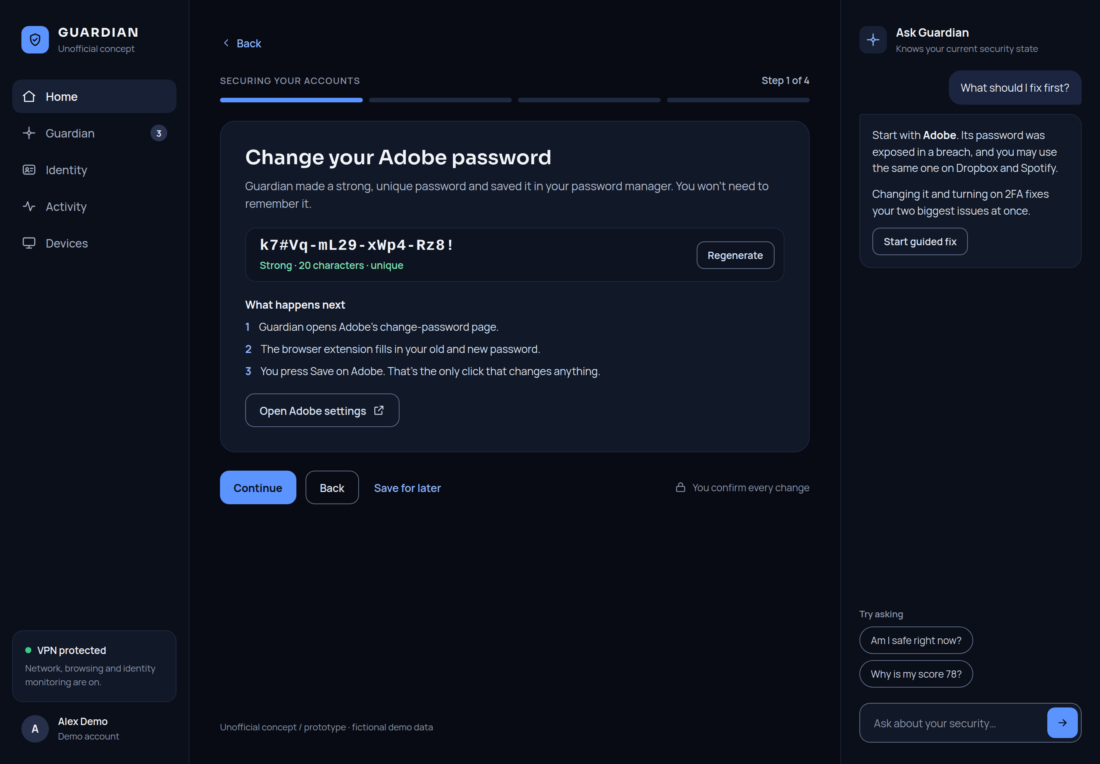
5 steps- 01 Generate GoalA strong, unique password is created
- 02 Open GoalGuardian opens the exact change-password page
- 03 Fill GoalThe browser extension fills in old and new passwords
- 04 Confirm GoalYou press Save. Nothing changes without you
- 05 Verify GoalGuardian checks the password is unique and not breached
Confirm is the one step Guardian never does for you.
05 Decisions
Trust came first: nothing changes without the user.
- Nothing changes without the user Silent account changes break trust, and trust is the product
- The warning is never behind a paywall Someone whose password leaked must learn it for free
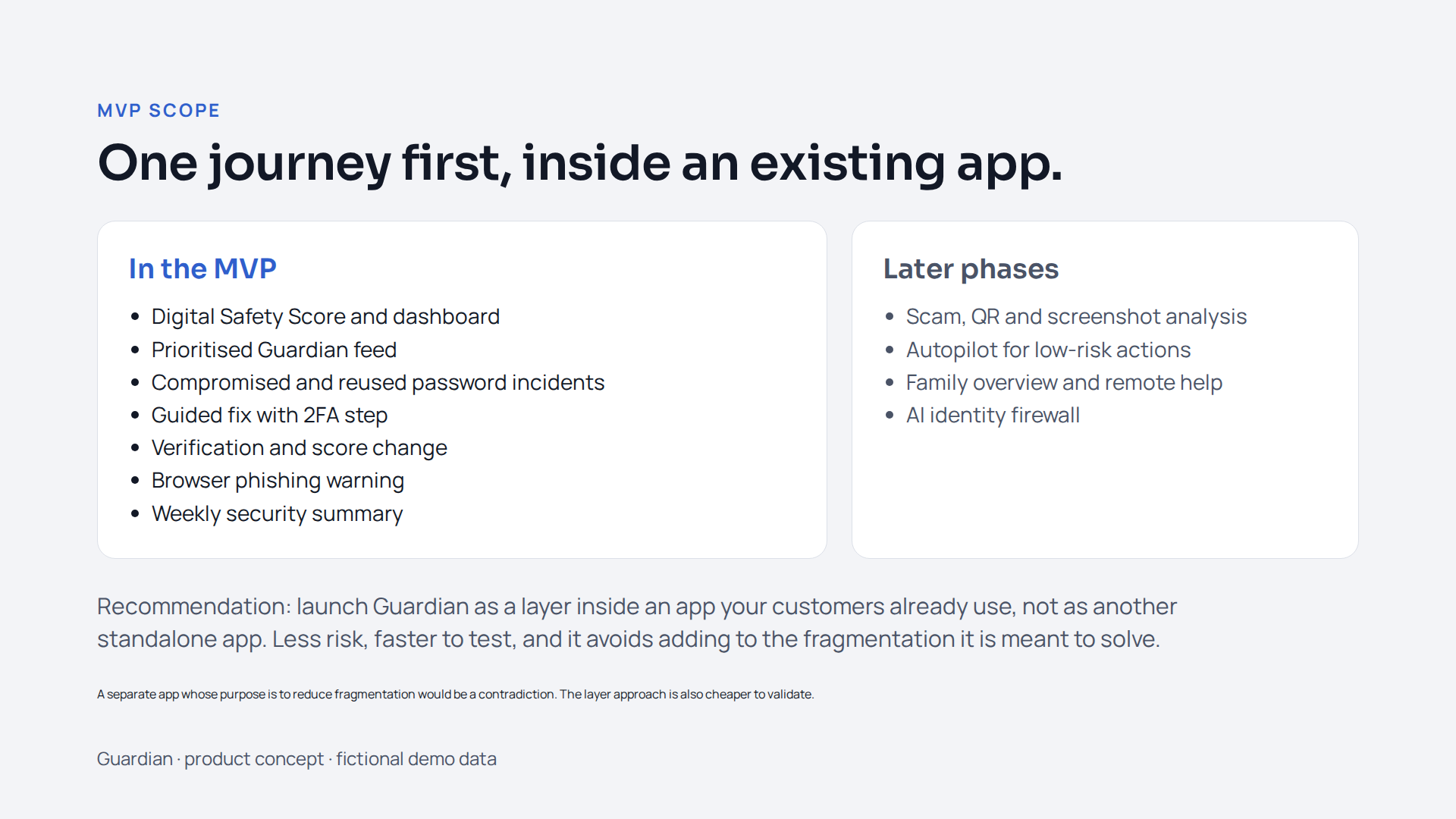
- A layer inside an existing app, not a new app A separate app would add to the fragmentation it exists to reduce
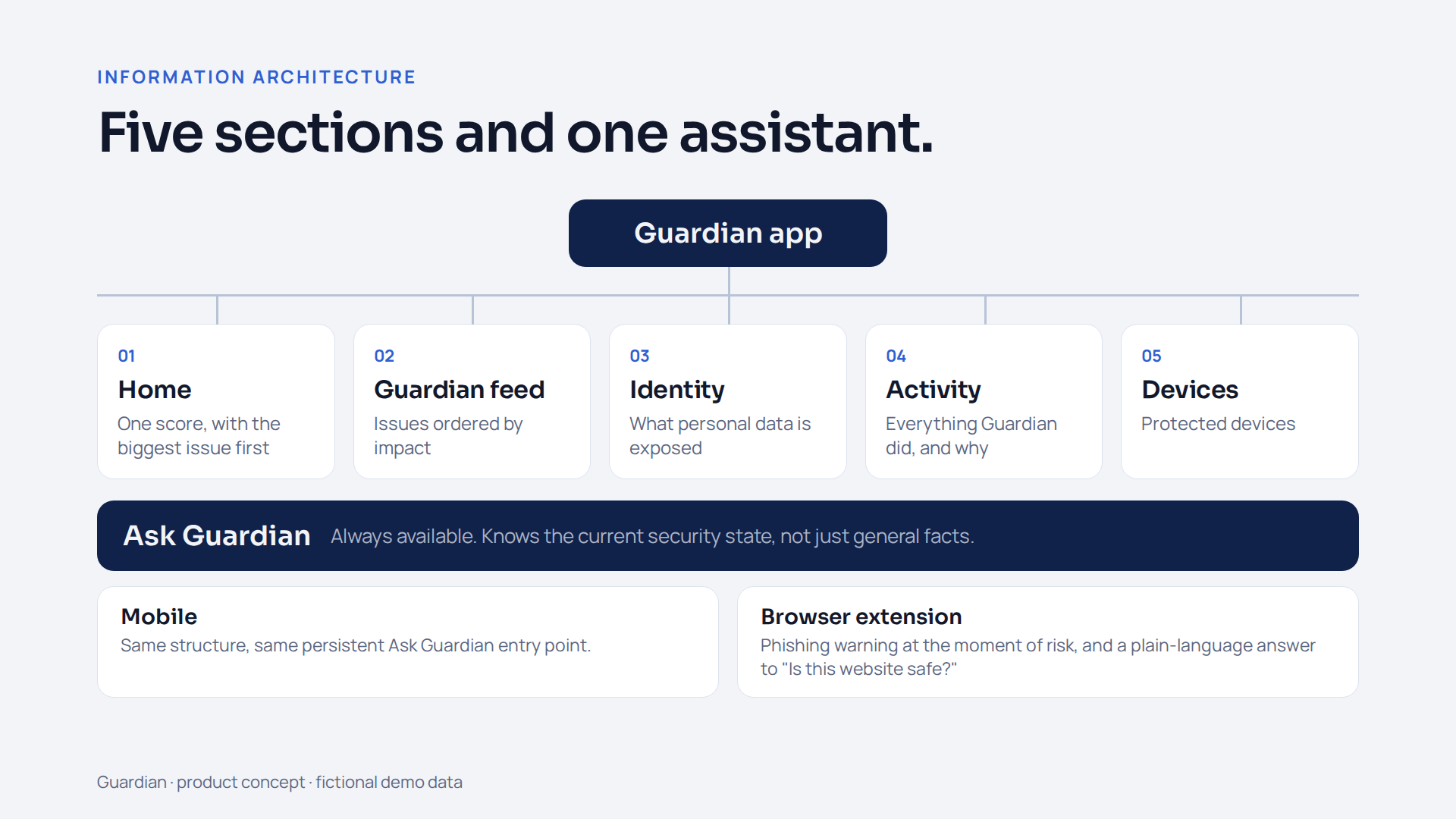
- Five layers, one score, one next step Nobody acts on five dashboards
06 Solution
One score, one next step, and a visible result.
- Calm, not alarming: urgency through hierarchy and plain language, not red
- screens
- Human language first: say what it means, not the jargon
- Action over information: one obvious next step per screen
- Visible progress: show what changed after the user acts
- Permission clarity: the user confirms every change
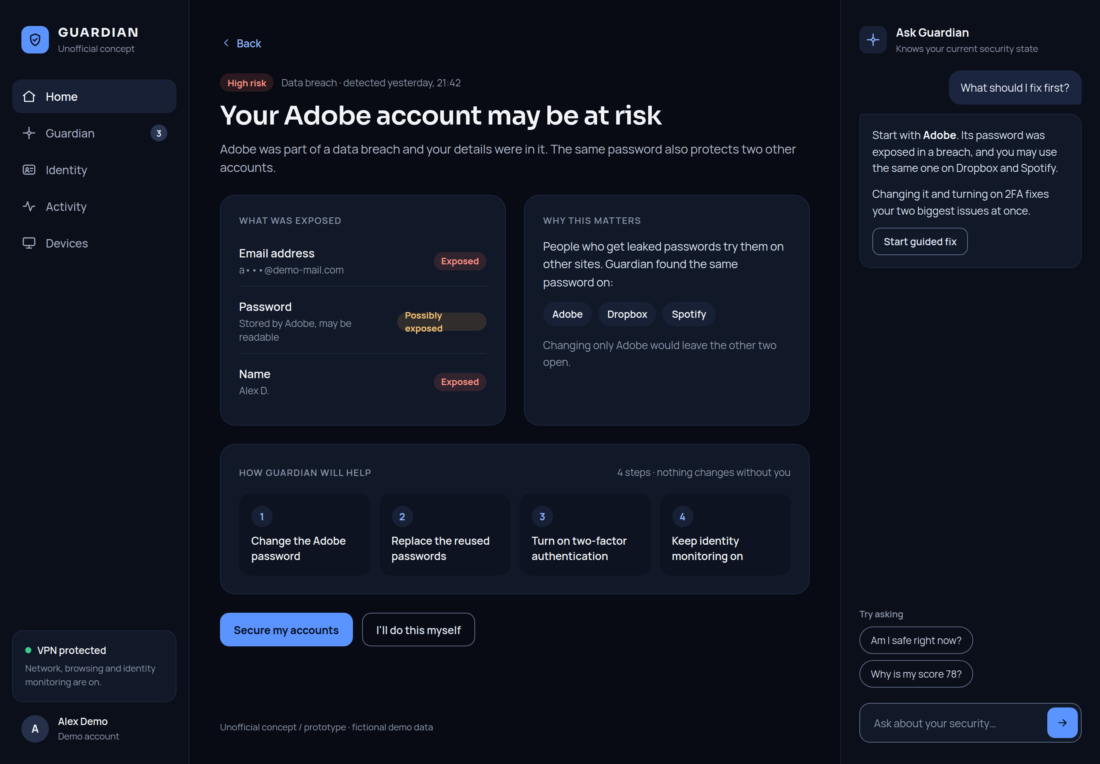
An alert that explains itself
Instead of a breach notice, Guardian says what was exposed, why it matters (the same password protects two other accounts) and what fixing it involves, before asking for anything.
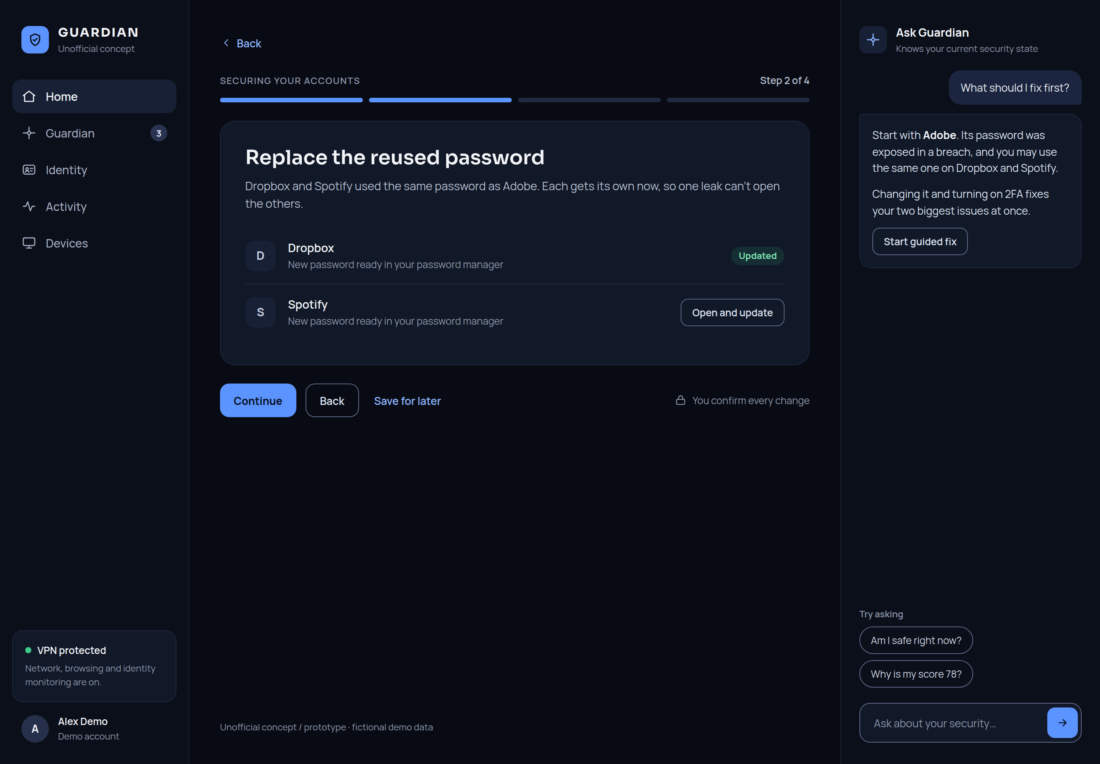
Incident
A strong, unique password is generated and the change is prepared, but the user presses Save. Every account reusing the password is listed and updated one by one.
The result is visible
The score rises from 78 to 91 and every change is listed, so the user knows exactly what improved.
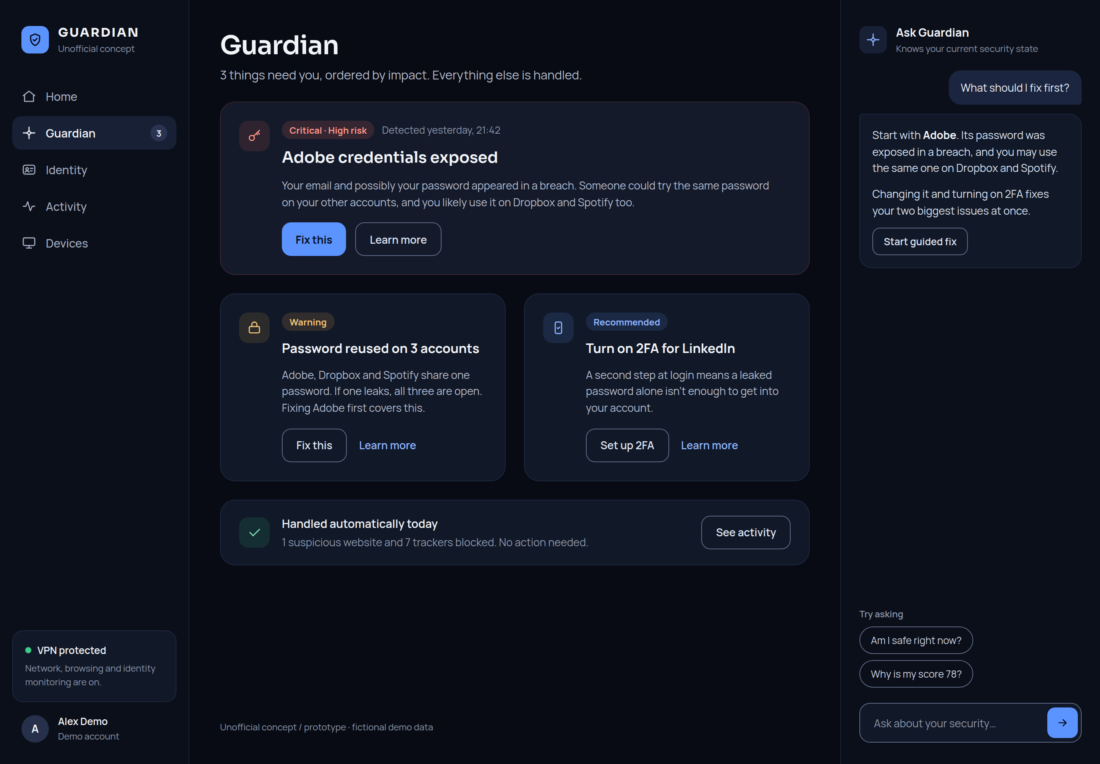
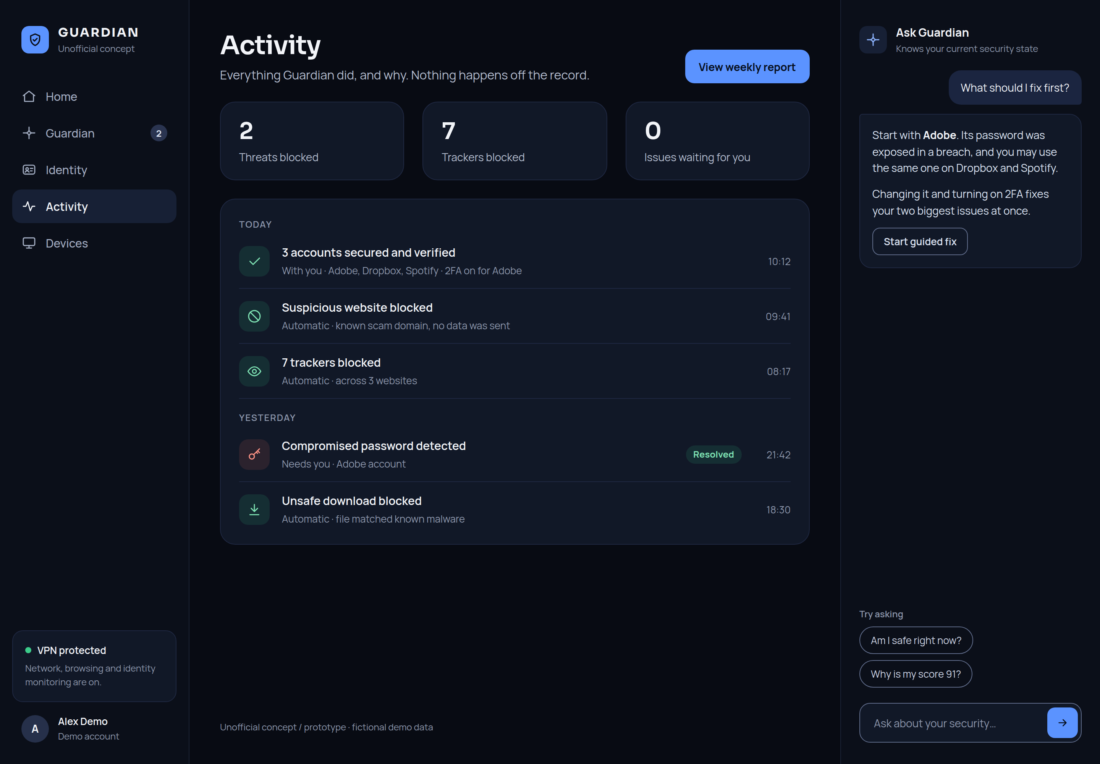
Prioritised and transparent
A feed ordered by impact instead of a list of alerts, and a log of everything Guardian did and why, so nothing happens off the record.
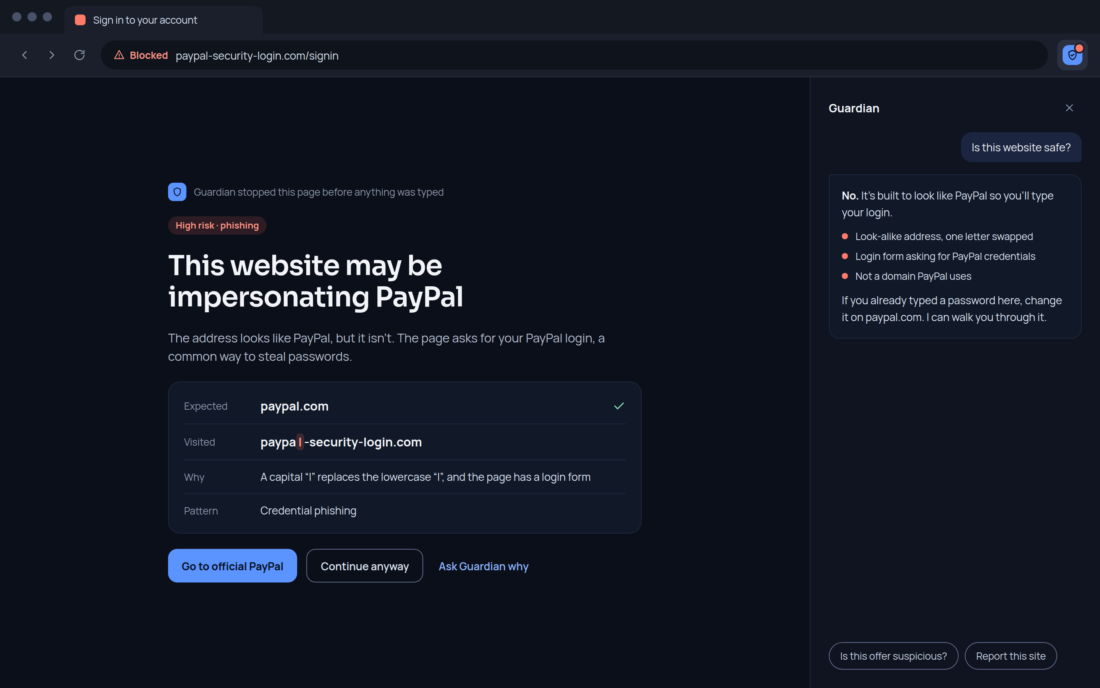
Stopping the next incident
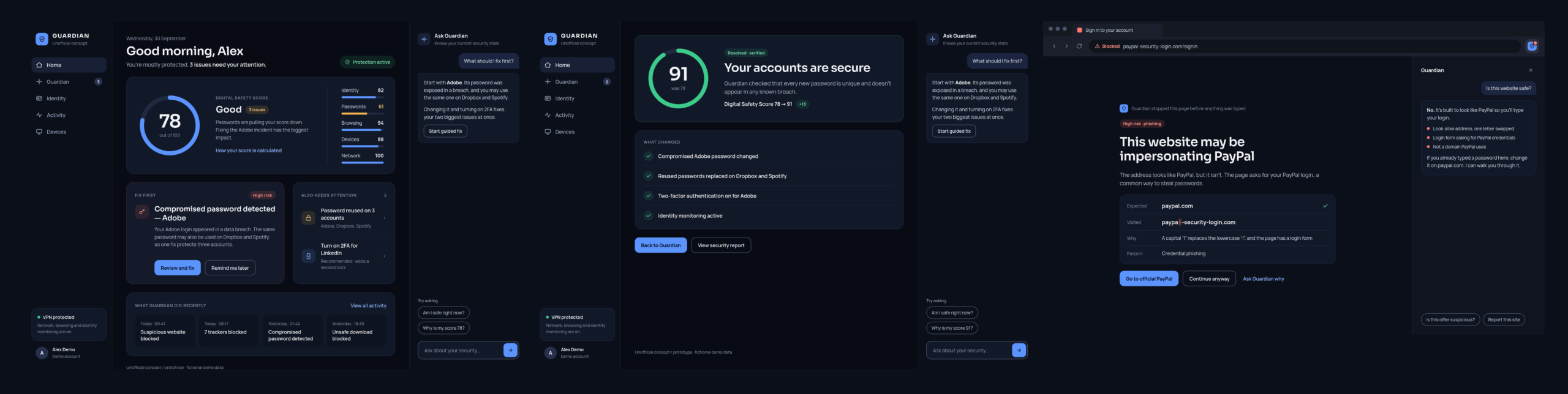
The browser extension steps in before credentials are typed. It shows the expected and visited domain side by side and highlights the single swapped letter.
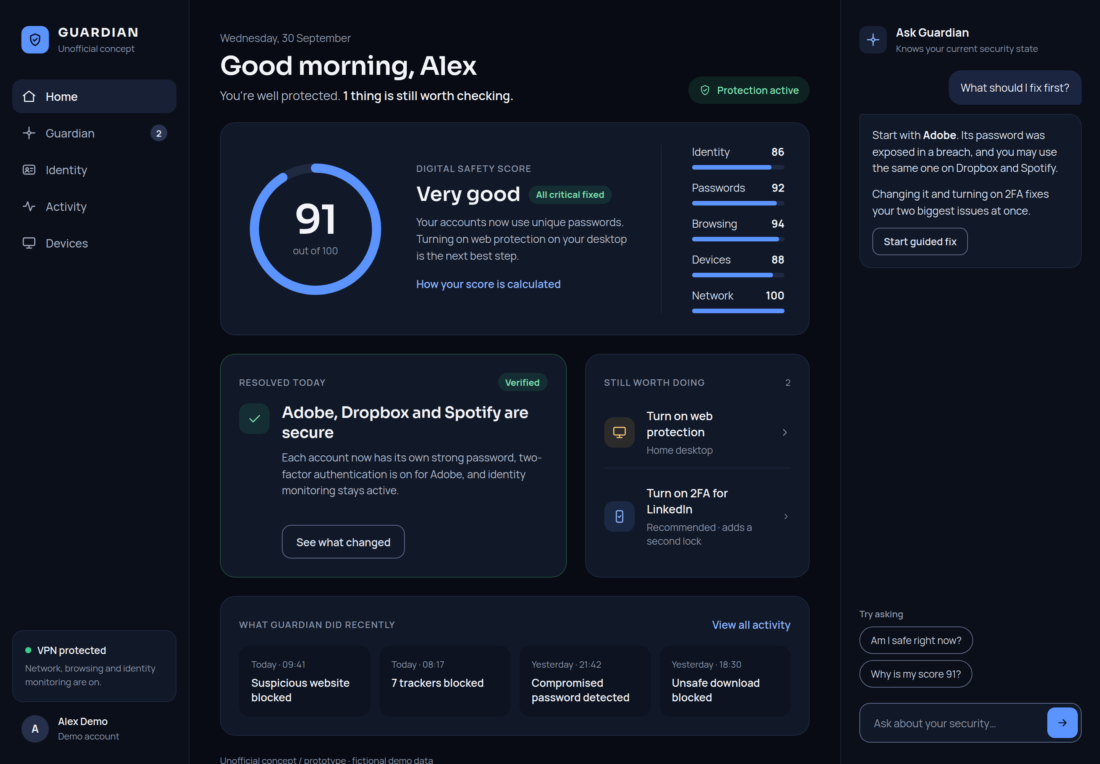
Home before and after one guided fix: score 78 to 91 (prototype scenario).
07 Results
A complete journey, designed and clickable; real numbers come from the pilot.
- Trust belongs in the product, not in a settings page: the permission model is part of the interface.
- A product that exists to reduce fragmentation cannot be another standalone app.